Wednesday, October 22, 2014

Advantages, or Opportunties Lost?

The number of students taking online courses in British Columbia is growing.  And while this growth has slowed slightly in the last couple of years, the impact of the rapid increase from 30000 to nearly 80000 unique students taking one or more courses from BC distance education facilities is something that I have begun to notice at our school.  Our district is no exception--for example, more than 300 students were taking online Physical Education last year.  And while it may seem paradoxical that students are taking a physical activity course on the computer, it is happening.  And not just in PE.

To be quite honest, when asked, I have been cautious about recommending online courses for students.  I have always felt that the online learning environment can be effective for certain students, but for others, online courses can be much more challenging to complete.  I have always felt that a 'regular' classroom is a better place to learn than in an online environment.  

I fully acknowledge that I have a bias: I am a product of the public school system, I work in the public school system, and my children are in the public school system in typical, 'bricks and mortar' classrooms.  For all intents and purposes, the public school system has served my family very well.  But the reality is that more students are finding alternative ways to explore their passions and get credit for it at the same time, and as a result, those students are moving away from the traditional 'bricks and mortar' schools.  I also acknowledge that my experience in an online learning environment is limited--I did the Deeper Learning MOOC last year and got a great deal from it.  However, even with the scant evidence that I have to support my feelings--I feel the in-classroom experience has some decided advantages for kids.


Bearing these thoughts in mind, I began pondering a question: 


"What are the advantages for a student in a typical, face-to-face, 'bricks-and-mortar' school versus an online learning environment?"


I have asked a number of colleagues this question, and even posed the question in a survey on Twitter.  Here are some of the more common answers came back to me:

  • interact/work with others in a face-to-face environment
  • more 'immediate' interaction with a teacher and other students
  • someone there to motivate, inspire, and 'drive the learning'
  • getting to hear the ideas of others
  • a diversity of hands-on activities
  • being a part of a culture, something larger than the individual
  • student-student relationships
  • student-teacher relationships
And while there are likely numerous other pieces that we have not considered (and please feel free to add them to this survey), I want to evaluate each of the advantages above, but focus in on each of them with a slightly 'tighter' lens, which is

Are we consistently leveraging the advantages that we say that we have in 'bricks and mortar' schools?  Considering each of these advantages, if evidence to support these factors is difficult to find on a consistent, classroom-to-classroom basis, then these are NOT true advantages that we are leveraging. Instead, one might argue that they are little more than lost opportunities.

So here we go, let's examine them, one-by-one...

Interact/work with others in a face-to-face environment:
Working with others in a face-to-face environment is a skill that has been both deemed as necessary and condemned as being lost with today's student, all in the same breath.  And while there are certainly more jobs that can be done 'remotely' or from behind a screen, the majority of jobs and interactions that students are going to have in the next few years are still going to require face-to-face interactions and cooperation.

But ask yourself this....

What are the nature of the interactions that are taking place in classrooms?  Are students actively taught how to effectively collaborate in partnerships, triads, small and large groups? Are there driving questions and opportunities for kids in the class to dialogue and practice these skills?  Are the tasks that students are asked to do requiring them to participate and interact with each other?   Are the tasks ones that require positive interdependence between the students, or for them to simply to do their part? Is the seating arrangement in the classroom conducive to these sorts of conversations?  Is the length of time spent on these interactive activities long enough for students to become proficient at these skills and make them transferable to other situations?  

Someone there to motivate, inspire, and drive learning:
Each of us has had those teachers who were truly inspirational, that got to know us, and got to know what our strengths and interests were both in and out of the classroom.  They took something as boring as Ohm's Law or poetry and turned it in to something that was both interesting and meaningful.  Their passion for their subject area was second only to their passion for us as students in the classroom. They kept us on task and roughly moving in the same direction.  It was awesome.

But ask yourself this...
What percentage of your teachers or university professors fit the above description?  100%?  10%?  1%?How many of them tried to determine what motivates students to learn?  In our schools, do we ask students what their motivations are, or do we assume they are driven by things like grades, university, or the promise of a better life (which may or may not be so applicable to a rambunctious Grade 7 boy who has just come in from the playground)?  Do we ask driving questions (check out the 'Tubric' from the Buck Institute), and use tuning protocols to empower students in their learning, or do we come up with the activities in isolation, and hope that students want to do it? Do we think of learning from a  developmental perspective, honoring the fact that if we create our lessons with the acknowledgment that students come from different backgrounds and have different skill sets, that they will be more motivated to do the task? Do we try to determine what gets students into 'flow'?

If we don't do these sorts of things to inspire our students, we cannot lay claim to having someone there to inspire and motivate as an advantage--we can only lay claim to having a person...well...there.

Getting to hear the ideas of others:
There is no doubt that crowd-sourcing an issue is going to lead to a more diverse set of solutions.  Among many examples, Steve Johnson's "Where Good ideas Come From" talks about the collision of smaller hunches to form bigger ones, and the Professional Learning Community model of collaboration both point to the power of the group versus the individual.

But ask yourself this...

Do we consistently give students tasks that require multiple perspectives and multiple solutions?  Do we actively demonstrate to our students that there is more than one way to accomplish a task or meet a learning outcome?  Do we 'go wide' with our students, asking the shortest question possible and then encourage divergent thinking?  Do we create a safe forum for this to occur, and have students display their learning in such a way that it allows others to comment on, critique, and draw inspiration from to affect their own work in a positive way?

If we have students do tasks that require one answer or that can be copied from a book/website/peer or have students demonstrate their learning in ways that are not visible to their peers, this cannot be considered an advantage.

A diversity of hands-on activities:
Individual work.  Group work.  Driving questions that require creative solutions. Peer review and evaluation.   Labs.  Projects.  Role plays. Digital portfolio work.  Video creation. Connections with the community.  Field trips.  Internships.  Cross school/district/country collaboration using technology.    The list of possibilities goes on and and on for activities to do in the classroom with students.

But ask yourself this...
What are the typical tasks that students are required to do in each of the classes in our schools.  I can say with honesty that some of my science classes were predominantly textbook based, with the 'where's Waldo'-style review questions at the end of a section, potentially a lab, and then some sort of quiz or test.  Occasionally I did a debate, role play, or something that I thought was pretty cool (although I am not completely sure that the kids agreed with me). However, for the most part, I felt as though I had a great deal of content to get through and didn't have a lot of time to 'waste' on these sorts of activities.  I rarely did any task analysis to see what my students were actually required to learn as a result of doing the tasks in my classes.  Looking back, I could have truly empowered my students in their learning by having them involved in task development:  I could have used a variety of different activities that would have been designed with a focus on  'how best will students learn this' rather than 'how best can I cover this material'. 

If students are mostly exposed to textbook/worksheet based tasks with quizzes and tests that are multiple choice, matching, short answer and long answer questions, we are not maximizing our opportunities to engage kids with the activities that are possible in a face-to-face environment.

More 'Immediate' Interaction with a Teacher and/or other students
For a variety of reasons, students in an online environment may experience a 'lag' in terms of needing versus getting assistance.  And if the online experience is such that a student is working individually and asynchronously, the odds of the student being able to work with their peers can be 'hit and miss', depending on who is online or whether such a mechanism has been set up with that particular course.  In the 'bricks and mortar' classroom, the students are in physical proximity to the teacher and eachother, and most often are learning synchronously.

But ask yourself this...
Can the student access the teacher at any time, and if content coverage is a norm, is there even time for students to get help from a teacher?  And if not the teacher, are there mechanisms for peer support that have been created and actively taught in the classroom so that students can get this 'immediate' interaction?

Being a part of a culture, something larger than the individual
Friday night football, Texas-style.
Last year, I got to cross off a 'bucket list' item when I was able to go to a Friday night, high school football playoff game in Texas.  The kids were there in school colors.  The parents were there in school colors.  The marching band was there in school colors, playing the school song.  The home town was there.  The visiting town was there.  Everyone was there.  I got goosebumps just sitting in the stadium, thinking that I was a part of something amazing--even if I wasn't from Texas.  

LINK Crew - Day 1!
Of course it's not about football, it's about that connection to the school, the colors, the mascot, and the community.  To be a 'Sabre', a 'Dragon', or a 'Bulldog' right along side of the rest of your peers.  But if we don't consciously and consistently create opportunities (like LINK Crew, peer mentorship, spirit days, intramurals, recognition assemblies, etc) for our students to connect with our school and the people that work there, they are not a part of something larger than themselves.

Student-Student Relationships:
Students love to come to school to see their friends and socialize.  They love to work with each other in class, and play with each other at lunch.  

But ask yourself this...
As schools, do we cultivate these relationships, and ensure that they are positive and productive?  Do we have programs such as Me-To-We, RespectEd, Roots of Empathy, and Safe Schools.  Do we monitor our progress and how students are feeling about our schools through Student Voice, Satisfaction Surveys, tools like Tell Them From Me, and focus groups.  And when we get this information from our kids, do we respond to it so they feel better about connecting with each other and the school.  Or do we hope for the best, and allow the "Law of the Jungle" (a tongue-in-cheek quote from one of our excellent staff members) to manifest itself in our hallways with a "they need to sort it out" philosophy?  

While this area is not a dichotomy, we need to help students with developing positive relationships with their peers.  Adults need help with their relationships all of the time--why would kids be any different? 

Student-Teacher Relationships:
This could be the biggest leverage point of all for bricks and mortar schools!  Research validates the statement that kids 'don't care what you know until they know that you care'--in fact, the teacher-student relationship has seven times the impact than does the teacher's knowledge of their subject area.  What an advantage, right?

But ask yourself this...

How are we getting to know our students, or are we really getting to know our students at all?  Would our students say we have positive student-teacher relationships in each of our classrooms? Considering there is a repository of ideas only a few mouse clicks and key strikes away for getting to know our students, do we use these sorts of activities to create connections between ourselves and our students?  How do we determine the prior learning and individual contexts of our students?  Do we believe in that respect is something that is earned, and therefore that we must earn the respect of our students and their parents?  Are we vulnerable in front of our students, and comfortable telling them that we don't have all the answers, and it's ok?

If we do not actively cultivate these relationships, we have lost one of the very biggest potential advantages of a 'bricks and mortar' school.  


In conclusion, I want to add one big qualifier--each of our schools is doing many of the things above, at the least in smaller pockets, and sometimes full-scale.  And should we leverage each of these opportunities that we have with children in our schools, there is no one who could convince me that the online experience would be superior to the in-class experience for student learning.  Yet given the proliferation of students choosing alternative options to pursue their passions while concurrently getting credit towards graduation, I think all 'brick and mortar' schools need to take a sincere look at each of these opportunities for us to enrich the in-class environment to see whether they are truly advantages that we are realizing rather than tremendous opportunities that are lost.


This has been cross posted in the Sa-Hali Educational Sandbox.

Friday, May 23, 2014

Working with High Tech High - Part 1

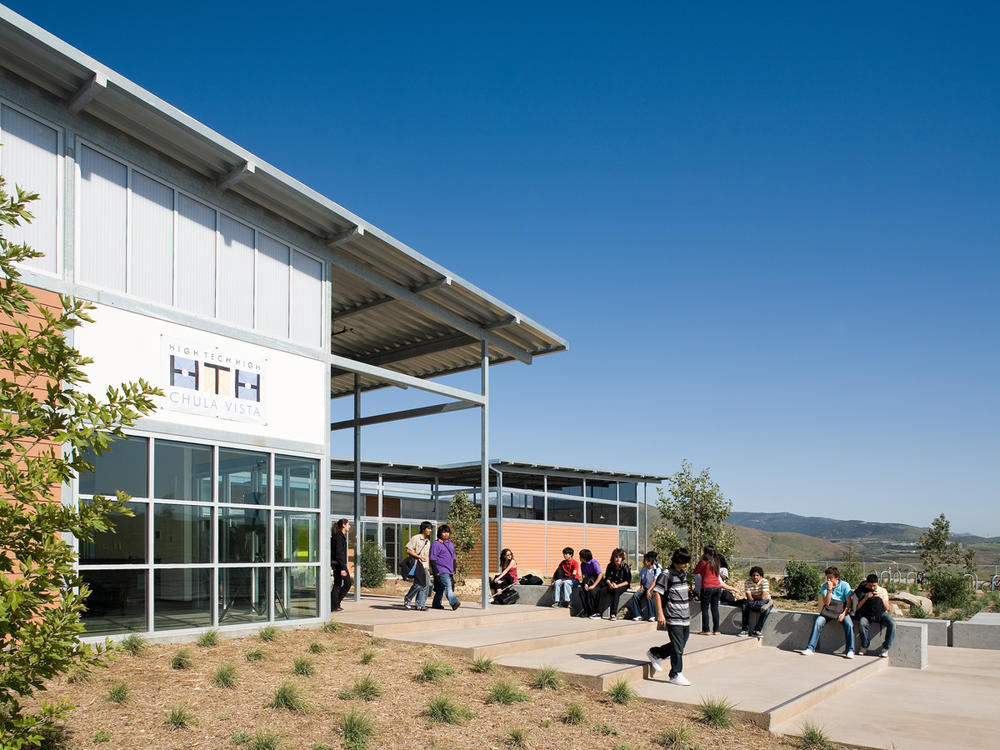
Several months ago, we hatched the idea of a school of unique and innovative teaching and learning.  The driving vision for this school is “Sa-Hali Secondary School will be an exemplary learning environment for students, teachers, and future teachers. Through innovative educational practices, we will design and implement meaningful, problem-based learning tasks that, through their real-life application, require learners to demonstrate and apply our collaboratively-developed attributes that will prepare them for an ever-changing future.”  As a staff, we have been working towards realizing this vision on a variety of fronts:  we examined the importance of deeper learning, we have been crafting our attributes, and have begun the process of increasing our understanding of task analysis, ‘learning to see and unlearning to judge’ and the collection of descriptive observational data to allow us to scale up innovative deeper learning practices in our building and our district.

Inasmuch as we have made great strides, naturally there have been many questions and concerns about what our journey to create this environment of deeper learning could look like.  To help us along this pathway, our professional development committee determined that we needed some exemplars of learning environments that modeled deeper learning.  After a great deal of planning, we were able to bring High Tech High teachers Chris Wakefield and Anthony Conwright to our school this past week for our May Professional Development day to introduce us to the practicalities of PBL.  And if there was one word to describe the session that our staff had with Chris and Anthony, it would be ‘outstanding’.  

The session was incredibly dynamic.  There were ice-breakers, followed by short instructional bursts and demonstrations interspersed with small and large group activities.  There were exemplars of projects and ‘beautiful work’ throughout the library for each of us to touch, pick up, and examine.  There were multiple opportunities for reflection.  And ultimately, small groups were taken through the process of creating and tuning projects that we will use in our classrooms.  We learned the work by doing the work.

Personally, I had several takeaways from our session, including:

  1. We need to give students training in giving critique and multiple opportunities for revision.
  2. Our collaboration model needs to evolve to utilize the expertise of multiple departments.
  3. The tuning protocol used by HTH has multiple applications, especially for administrators.
  4. We have numerous artificial constructs that inhibit creativity.
  5. We are limited only by our imagination when it comes to PBL.

Over the next couple of weeks I need to unpack each of these separately.   But I am going to start with the first one.

We need to give students training in giving/receiving critique along with multiple opportunities for revision

When I was a teaching senior biology on the Copernican timetable, we did a lab nearly every day.  Within those labs, students would have to do a practical, hands-on piece such as a dissection, document the process they used, and explain their findings using a combination of drawings and written description.  The students would do these lab write-ups using a template that I had given to them at the start of the year.  Armed with a big new red pen, I would pick a night during the week and strap myself in with a big pile of student work and begin marking.  And much to my chagrin, I would often see work that was messy, inaccurate, and often times incomplete.  I would find myself making the same comments over and over--’where is your evidence?’, or ‘you labelled this incorrectly’, or ‘it’s “gizzard”, not “blizzard”’.  

I would return the work with a big “10 out of 15” on the front, and to my surprise, a large percentage of students would look at that big red mark on the front, shrug their shoulders, fire it in their binder (or the trash), and move on to the next lab.

And make the same mistakes again.  And again.  And again.  And guess who was to blame?  

Me.

Guess who was getting better at giving specific feedback?  Guess who was getting the benefit of looking at great (and sometimes not so great) drawings and insightful answers?  Truthfully, guess who was getting better at doing labs?

Oops.

One of the things that Chris and Anthony from High Tech High stressed was the importance of public critique and providing students with multiple opportunities for revision.

They began by showing a video called “Austin’s Butterfly”:  this video shows Ron Berger (Chief Program Officer of Expeditionary Learning Schools and a leading advocate for ‘beautiful work’, working with primary and intermediate students on the concept of kind, specific, helpful feedback and multiple revisions.  Take 6 minutes and watch this (if you haven’t seen it already).


Then, Chris and Anthony gave our staff multiple progressions of a project, and had our staff practice giving kind, specific, helpful feedback that would make the project better and better.  The small groups discussed each progression and saw first hand how their feedback could make the project better and better.

This process was powerful in a few different ways.  The small groups saw the project getting better as a result of the feedback, as one might expect.  But these critique groups learned together--they learned about giving kind and helpful feedback, they learned from each other’s comments, they saw their comments build on themselves and get even more specific and meaningful, and they learned that by giving students multiple opportunities for feedback in a public setting, the products and producers improved immensely.

I look back now on my time as a biology teacher and shake my head at myself.  Wow, could I have done things differently.  I could have had the students working in small groups (and then larger ones) to give each other this kind, specific and helpful feedback.  They would have been able to improve each other’s work in a kind and non-threatening manner, and would be able to look at their own work more critically at the same time.  And in the end, when their work came to me, it would have gone through multiple revisions and a couple of dozen different sets of eyes.  

If we compared the consistent quality of work that students would produce using this approach to the work from the “one and done” (set of eyes AND opportunity) approach that I used, well, there would likely be no comparison.

As a staff, we need to design and implement activities that utilize multiple revisions and public, kind, specific and helpful feedback for our students.  As an administrator, I need to use a similar approach to the things that I do with staff.  We have great collaborative team leaders and a very knowledgeable faculty.  Like our teachers, I need to ensure that I use the collective knowledge of the group to give me kind, specific and helpful feedback on multiple iterations of projects that we will undertake as a staff so that in the end, we have ‘beautiful work’ of our own.

Part 2 Next Week - Our collaboration model needs to evolve to utilize the expertise of multiple departments.


*cross posted at The Learning Nation

Tuesday, April 22, 2014

Tying It All Together - PLC with a Twist

Our Staff Commitments
My first year has in my new school has been an eventful one.  In the span of eight months, we have created a model for inclusive staff meetings,  co-created a set of staff meeting commitments, asked the shortest questions possible in making our collaborative group model, developed a common vision, co-created a method for understanding our Pyramid Response to Intervention model, begun to embark on our model of creating a school of deep learning, and have begun to investigate classroom observations through task analysis and "learning to see and unlearning to judge" with the goal of doing Instructional Rounds in our school in the fall.  Not to mention, we sent a group of our department coordinators to the Professional Learning Communities summit in Phoenix in February, and they have subsequently helped to train our entire staff on effective collaboration at our last four full-faculty collaborative sessions.  And today, we tied it all together at an evocative and engaging professional development session that our PD committee put together to consolidate our 'attributes of a graduate' that we will finalize by the end of the year in order to guide our next fall and in the future.

I know what you are thinking.  Just like me.  Enough already.

On Thursday, I made a promise to our faculty.  No more. No more initiatives. No more programs.  As much as it is in my control, there will be nothing further coming from my desk for the staff for the next couple of years.  This is not to say that we will be standing still, in fact quite the contrary: the hard work is just about to begin.  However, I believe that it is time for us to start filling in from the edges.  To borrow the analogy from one of our teachers (@MrJdeVries), much like a large and complex jigsaw puzzle, we have put most of the edge pieces together, and it is time to see how it all fits together for us.

I believe that we now have the key elements to move forward, to co-create, to innovate, to observe, and to reflect.  And I believe that our focus comes through the lens of the four questions of the Professional Learning Community...with a bit of a twist on each one.
  1. What is it that we want students to learn?  In working with our staff, students and community, and in conjunction with the changing curriculum from the BC EdPlan, we are looking at a narrower and deeper set of content standards.  The Twist:  we will be focusing on creating compelling, driving questions and inquiry-based/problem-based tasks that will require students deeper learning in demonstrating these content standards through the attributes that we want for our graduates. Furthermore, beginning with our Grade 8s, we will involve students in the co-creation of these questions and the problems associated with these questions using tools inspired by those such as the High Tech High Project Tuning Protocol so we can maximize student engagement in their learning.
  2. How will we know that they have learned it? We will be augmenting our existing assessments with collaboratively developed formative assessments in our content areas using our collaborative time. The Twist:  We will design and implement rubrics that measure our attributes (such as those from the Buck Institute) and also co-create structures for our students to do presentations of
    their learning.  By doing this, we can more accurately assess student and instructional strengths and weaknesses in both our content and attribute areas to help better meet the needs of our students and provide feedback to our staff.  And furthermore, by having students present their learning, we will develop transferable skills using 21st century tools, provide meaningful accountability, and allow students the flexibility and choice to be creative in demonstrating 'what they know'.
  3. What will we do when they have not learned it?  We have spent a great deal of time on our Pyramid Response To Intervention model, and we continue to assess its effectiveness and brainstorm ideas to change it so it best meets the needs of our students who are not able to demonstrate content 
    The Sa-Hali Support Network--PRTI at work!
    outcomes or our attributes.  The Twist:  Using our classroom observations, 'learning to see and unlearning to judge', the Instructional Rounds concepts, and reflection time during our collaborative meetings, we will continue to develop the culture that uses multiple sets of eyes to give us descriptive feedback (our staff, other teachers, pre-service teachers) on departmental and attribute-based 'struggle points' to improve student achievement and pedagogical practice. The one thing we will will not do? Expect less from our struggling students in terms of their ability to do high quality work that requires deep learning.
  4. What will we do when they have learned it?  Honestly, we hope that our students have never 'learned it'--we hope they will have applied their learning in a way that contributes to existing knowledge and creates new solutions.  We hope to have our students as co-authors of curriculum and co-contributors to our knowledge of how students learn best through their being partners with our staff--models such as that used at Farmington High School in Connecticut.  We hope to push our students farther into the community to provide real-life experiences and internships that make the transition from school to post-secondary less of a leap and more of a stride. Perhaps that is not such a twist after all.
We are finalizing our attributes which will guide us.  We have collaboratively developed structures in place to support student learning and educator learning, and a set of co-created commitments that will allow us to work together, as a team.  With this framework and a movement toward deep learning and innovative pedagogical practices, I feel our school is ready to tie all of this together and fill in the pieces of the jigsaw puzzle from the outside to in.  And with a very positive Mid-Year Review from our School Board Office, we are ready to go.

And while things may and will change over the next few years, it is time for us to do the heavy lifting and consolidate our ideas.  

Exciting times are coming!  And we will make this happen together.


Friday, March 7, 2014

Looking at the "Why"

As part of my own professional development and to further my understanding of how massive, open, online courses work, I signed up for the Deeper Learning MOOC offered by a series of experts from High Tech High and a variety of other organizations noted for their work in deeper learning.  And while I have not done every task associated with the course, I have made it a priority to watch the archives of the panel discussions each week after my little ones head off to bed.  The discussions are engrossing and invigorating, and as I have felt like my motor has needed a bit of a jump start this week, I was particularly excited about Monday night's topic of 'Assessing Deeper Learning'.

Right now at our school, we are investigating how we can 'dig deeper' into deeper learning in each of our classrooms in our school.  We are being deliberate in our steps to lay the ground work for digging into deeper learning through:
  • creating a set of attributes that we want for our graduates (September)
  • refining those attributes with the help of our students, parents and community (October-March)
  • examining the 'whys' of why we need to have students learn deeply in our classes (Jan/Feb)
  • beginning to develop a common language around effective practices that require deeper learning (March)
  • co-creating a mechanism for every staff member to go into other classrooms to co-plan and observe deeper learning practices (March)
  • creating a culture of 'learning to see, unlearning to judge' so that we can observe and describe the deeper learning that is taking place (April)
  • inviting deeper learning practitioners to work with members of our district and our staff (May)
  • visiting schools that are requiring deeper learning of their students (June)
However, as much as we are now in March and have taken the initial steps listed above, my participation in the DL MOOC coupled with the conversations with teachers at our school has changed my thinking about this plan.

In Monday night's panel discussion on 'Assessing Deeper Learning', moderator Rob Riordan asked a question of the panel from the audience which was "Can you talk about the transition of schools that might have a more traditional, 'no excuses' type approach in their pedagogy moving to deeper learning?".  This question was interesting to me, because we are just beginning our journey to more pervasive, deeper learning in our classes.

Bob Lenz of Envision talked about data and the importance of using data to guide discussions, and of particular note to him was about the examining the resiliency of a school's graduates in college.  In his opinion, by looking at this resiliency data, schools who were moving in the right direction were seeing data that suggests students had not acquired the skills to be independent learners, and were at least asking the right questions as to why this was occurring. 

Interesting.  I do not have this data.  I would like to get such data.

Megan Pacheco from New Tech Network then spoke about how schools who are being successful in making such a shift have spent a great deal of time on the WHY, and understanding and making sense of the outcomes that will help develop this common why. She went on to discuss how we often jump to new instructional approaches such as problem based learning without spending enough time on the WHY, and that it was more important to spend the time developing a commitment to the vision of your graduate and the types of skills that you want to develop.

Even more interesting.  And as a result, I think I need to work with our staff to alter our plan.  I think it needs to look more like this:
  • creating a set of attributes that we want for our graduates (September)
  • refining those attributes with the help of our students, parents and community (October-March)
  • examining the 'whys' of why we need to have students learn deeply in our classes (Jan/Feb)
  • begin to develop a common language around effective practices that require deeper learning (March)
  • re-visit the WHY, and find ways to encourage people to speak, to tell stories and construct their own contexts and meaning around why deeper learning for students is important;
    • after re-visiting the why, co-create a mechanism for every staff member to go into other classrooms to co-plan and observe deeper learning practices (March)
  • again, re-visit the WHY, and find ways to encourage more and different people to speak, and find examples, data and research to allow the WHY to become even more authentic on a variety of different fronts
    • then, create a culture of 'learning to see, unlearning to judge' so that we can observe and describe the deeper learning that is taking place (April)
  • continue to re-visit the WHY, with teachers and students bringing back examples of how they demonstrate deeper learning as exemplars
    • then, invite deeper learning practitioners to work with members of our district and our staff (May)
And really, I think we will find ways to re-visit why until we find ourselves are asking ourselves "Why are we still talking about why?" because we are so committed to the attributes and the vision that we have for our students. 

We aren't in this spot yet---quite far from it, in fact.  And too often my implementation scale is tipped towards the 'how' as opposed to the 'why'.  Thanks to the conversations that I have had with our teachers at the school and the panel in the DLMOOC, I look forward to finding new and innovative ways to contextualize the why with and for our school.

*cross-posted on The Learning Nation

Monday, February 17, 2014

The Shame of Classroom Visits

Coming to my new school this year, I made a concentrated commitment to be in classrooms more that I have ever been before.  Quite often, skepticism and eye-rolling tend to follow statements such as these, and rightfully so.  Each of us knows the typical pattern: the Principal makes these ambitious proclamations, does in fact show up in classrooms for the first few of weeks, and then steadily fades into the managerial quagmire that can consume school administration.  I know this because I have both seen this in my own administrators when I was a teacher, and followed this cadence as a Vice-Principal and Principal myself.  However, save for our monthly District Administrator Meeting that happens one Thursday per month and a couple of scattered meetings here and there, I have stuck to my regimen of being in classrooms during Period 2 each day.

And each day that I am in classrooms, I have the very same thought as I walk back to my office:  what a shame.

The shame comes not from what is going on in the classroom--quite the contrary, in fact.  The shame comes from the idea that the only person who really gets to see what is going on in our classrooms is, well, ME.  ME being the person who does not teach students on a daily basis.  ME being the person who does not regularly design lessons (except for faculty and team leader meetings) that are engaging, meaningful, and require the deep learning of our students.  ME being the person who does not develop and execute flexible, authentic assessments that allow students choice in demonstrating what it is they know in their courses.

This situation is going to change.  Not for me, because I still want to be in classrooms.  This situation is going to change for our staff.

Right now at our school, we are beginning our investigation  into how we require students to learn deeply in our classes.  Thanks to the hard work of our students and our staff, our results were very strong last semester--we had a 98.2% success rate in course instances in our school from September to January.  74% of our students achieved a "B" or "A" in each of those course instances.  And while not perfect, and while these are only gross, macro reference points, for the most part our students experience success.   However, as a staff, we want to probe deeper and look at things such as:
  • what tasks are we asking students to do?
  • what are students learning as a result of these tasks?
  • is that which students are learning in our classes preparing them for life in 2020, 2030, 2040, and beyond?
But if WE want get a better understanding of the answers to these questions, then WE need to have a chance to experience what it is that students and teachers are doing in other classes, not just our own.

Not just me.

However, going into other classrooms requires a number of different things (not just the release time) to take place so that we make the best use of that time.  These include:
  • Creating multiple entry points:  not everyone will comfortable having people into their classroom right off the bat.  We all know that when we have another adult in the room, we notice them.  Why? Because it happens so rarely!  However, others are very comfortable, and we don't want to neglect them either. Therefore, we need to recognize that there will be differing levels of comfort for everyone.  However, we don't want to have some of our faculty in classrooms observing and working with different teachers and not others.  So how are we going to do this? We will have three levels of observers and hosts so that people can move through this at their own pace.
    • Level 1:  Observer
    • Level 2:  Observer and Sa-Hali staff host.
    • Level 3:  Observer, Sa-Hali staff host and outside host(other district staff, Thompson Rivers University staff/student teachers)
  • Creating a Non-Threatening, Non-Judgmental Environment:  this is not evaluation, not at all. This is giving us a chance to get out of our classrooms and work with someone in our department, or another area altogether that is interesting to us!  Educators need to know that when a colleague is coming into their class, the colleagues are not judging, they are just seeing.  How do we do this?  Practice, of course.
    • Developing a common language of 'learning to see and unlearning to judge'
    • Developing our skills of descriptive observation using non-judgmental language
      • "when the teacher moved from Activity A to Activity B, 5 of the 17 students were able to move to Activity B" (descriptive) instead of "the pace was fast" (judgement)
    • Starting with video analysis from resources such as The Teaching Channel
  • Honing our skills of task analysis: we want to make sure that we have a clear idea of what students are actually doing (the task) as opposed to the activity that they have been given (the assignment).  We will begin to look at examples (here is a brief presentation that we will use to get started).
  • Being deliberate in our mechanism: we need to co-create a schedule that works for people and accommodates people, but it needs to happen.  The sooner we pre-load the activities above, the better so we can get started!
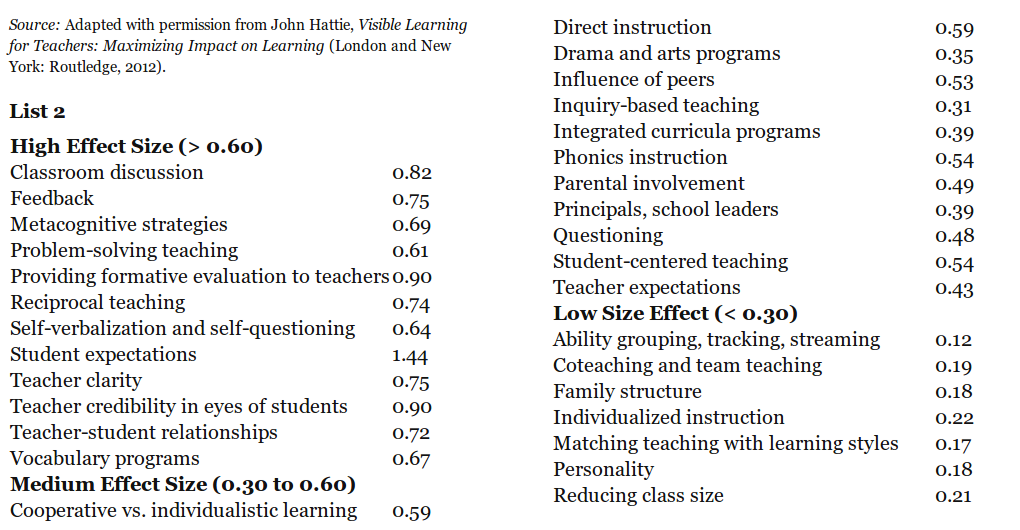
Yes, there will be some release time involved.  Yes, there will be some of my own time involved when I cover some classes for people.  But by being deliberate about getting educators in other educators classes, we will actually create powerful, meaningful and sustained professional development that is research-based in terms of its level of effect on student (and adult) learning (see below from John Hattie's 'Visible Learning').


So I will continue my classroom visits, but I believe that if we get our staff into each other's classes, not only will we learn, it will be meaningful, fun, enjoyable, and create a new culture of wall-less staff development.  And when I walk back to my office, I will no longer be thinking that it is a shame that more of our faculty do not get to see other classes and work with their colleagues.

Cross-posted at The Learning Nation

Sunday, January 12, 2014

Giving Students More Credit

This past Friday, I was fortunate enough to be in beautiful Kelowna, British Columbia to attend the British Columbia School Superintendents Association Conference on Innovative Practices.  It was an outstanding day of learning, marked by brief keynotes, short and direct breakout sessions, and plenty of opportunities for questioning the presenters, each of whom was a practitioner that was proudly sharing their innovation with smaller groups.

But most the most impressive and impactful piece from the conference took place in the first hour of the day. Hugh Gloster, Superintendent of Schools in Kelowna, had arranged for each of the 45 or so tables filled with educators to be paid two fifteen minute visits by STUDENTS from his district.  Each of these middle school students gave a brief presentation about how problem-based learning had impacted their educational experience to a group of complete strangers.

They were unbelievable.

Two different students came to our table and candidly described the pros and cons of PBL and how it had made a difference to they learned in their classrooms.  And after the students had finished, they answered every question that we could possibly ask them.  And they answered the questions well.

Each of the students was able to clearly articulate the attributes that they were required to develop and demonstrate.  They were

  • learner
  • thinker 
  • collaborator
  • innovator
  • contributor

I was impressed that each student was so keenly aware of what it was they were supposed to learn.  However, our time with the students got better:  each of them described how they saved artifacts of their learning in a digital portfolio, and then had to select a representative cross-section of them so they could best demonstrate each attribute through a Presentation Of Learning (POL) that they (and every other student) was required to do at the conclusion of each course.  And to top it off, they had to select a community member (which could be their parent, but didn't have to be) to be a part of the audience to whom they would present.

One of the students' set of responses was particularly intriguing:  she said she hated PBL.  More specifically, she hated problem-based learning AT FIRST.  She liked what she called a 'traditional class' with lecture, a video, worksheets, and a test at the end of the unit.  Why, I asked?  "Because it was easy.  You were always looking for one right answer.  So I could learn something for the test, and then forget it and move on."  (these were her words). But now, she was dreading heading back to a more 'traditional' style class (still her words)--she felt like in a traditional class, she would have little or no choice in what she was going to learn about, how she was going to learn about it, and how she was going to demonstrate her learning.

Wow.  This was a STUDENT speaking.

She said with PBL, she would never forget what she had done in her class because of the deep learning that she had done and the numerous reflections that she did over the course of the term.  She described how in the past in science, her whole class would have made a 'cell cake' to replicate a cell in Biology.  Everyone would have.  In her class, students needed to create their own analogy (she chose her home city), and as a result, the whole class made different ones and then learned even more ways to think about the cell from each student's presentation.  And then she said "I don't think that will happen in a traditional class.  I wish all of my classes were problem-based learning classes."

Again, I want to be clear, these were HER words. That is truly how she was talking.  She was speaking about HER learning.  She was not only able to critically evaluate WHAT it was that she had learned about in her project, she was able to critically evaluate HOW she learned best--a level of metacognition that I can say without equivocation that I have NEVER heard from a ninth grade student.  And the best thing was, the next student spoke in very similar terms.  And when I spoke to other educators who were at the other 40 plus tables in the room, they said the same thing about the students that had come to their tables.

How did this happen?  How could each of these students be able to speak to a group of adults about their own learning with such clarity and conviction?

Hmmm.

I began speaking to some of the adults in the room from the Kelowna district.  And when I spoke to them, each of them spoke of the five competencies.  Each of them knew what was happening in many of the classes at the middle school level.  And each of them believed that they were seeing success.

I asked an administrator where these competencies came from.  They told me that a process was developed to involve every partner group from support staff, teachers, administrators, students, parents and community members in the examination of research of the skills that students would need to be productive members of the future workforce.  They developed a mechanism for students to store authentic archives of these competencies (a digital portfolio).  And they created an evaluative tool that would allow students choice and the opportunity to showcase their learning in a setting that would further their skills in presentation and allow them to learn about how others approached the same problem.  And then they dedicated (and continue to dedicate) resources and professional development to make it happen

In my experience, it would not be uncommon when we have these sorts of committees to meet, to come up with ideas and methods of implementation, to put it out there, to get traction in small pockets, and to see very little evidence of that work coming to fruition.

This was not the case in the Kelowna district.  And to use Instructional Rounds parlance, my evidence is that, without coaching or a script, STUDENTS were able to demonstrate the products of the committee in their 'interviews' with the educators in the room--they were educating the educators.  There was a direct line from the work that was done in that group at the district office to the classroom. And it was amazing.

After this past Friday and a great deal of reflection on the way home, I have decided that, in my time as a teacher, I did not give students enough credit.  I thought I needed to be the person out front.  The one to sift through curricula and find for them what was truly important.  I gave them tasks that challenged them to do little more than find one answer that could be found on page 26, in boldface, near the end of the third paragraph.    I gave them tasks that had a single answer, or that created a single product like a poster at the end of a unit.  I evaluated them using a single instrument that, at least in some cases, worked best for...me. Something that was likely relatively easy to mark, but was probably quite exclusionary in that it required students to demonstrate their learning in a specific way, not demonstrate their learning.

I did not give students enough credit for being able to direct and demonstrate their own learning.

For me, this does not mean that tomorrow, we are going to simply throw our students and our educators out there on their own and say 'go find some problems, solve them, and show me what you learned'.  Not at all.  At Sa-Hali, we spent a great deal of time articulating the attributes of a Sa-Hali graduate that would help them meet the challenges that will confront them in their future.  We have started some of the leg work.  However, we need to get more stakeholders involved.  And we need to look at the existing structures and constructs that we have in our school that both help us and inhibit us in moving forward to create a model that allows students choice and flexibility in meeting and demonstrating the learning outcomes of their classes.

This will require time.  This will require resources.  This will require in-servicing and training for staff and for students. But most of all this will require a clear vision and subsequent commitment to that vision that we as educators will be co-learners and co-creators of the educational experience at our school with our students.
And at our staff meeting on Monday, we will get started on the process of giving students more credit for their ability to determine and demonstrate their learning.

This post was cross-posted at The Learning Nation.

Wednesday, October 23, 2013

Committing to Commitments

A few weeks ago, I wrote a post called "Inclusive Staff Meetings" - a description of how we were trying to create meaningful, and engaging staff meetings that encouraged risk-taking through a safe and collegial environment.  From that post:

"...we worked again in small groups on a Google Doc called "Staff Meeting Commitment Brainstorming" in which our entire staff worked together to draft ideas for commitments to make our faculty meetings safe for all of us.  A number of faculty members had never worked simultaneously and collaboratively on a digital document such as this in such a large group, and it was amazing to see every staff member engaged in meaningful dialogue with their peers...

Early in my career, in the interests of not wanting to 'take too much time on this stuff', I would have taken all of the information myself and tried to sort, classify, paraphrase, and make inferences in a process to pare down the information we had gathered into palatable chunks for the staff. At that point, I would have moved the commitments in a direction that I felt we needed to go, truncated the whole exercise, and moved on.  Without malice and in the interests of time, I would have inadvertently hi-jacked the process.

Like any school, we have hundreds of years of experience on our staff.  Our Coordinators are highly motivated, creative problem-seekers and solvers that are tremendously invested in their students, their classrooms, and their colleagues.  So regardless of how long the process takes, we will involve our entire staff in making a set of commitments that will allow everyone to be a contributing, engaged and valued staff member during our faculty meetings.  The information that we collected will come to our Coordinators, who will help to design an exercise with all of the feedback we collected that
  • requires the engagement of each staff member 
  • models the use of higher order critical thinking skills for our staff (interpretation, prediction, selection, synthesis, etc) in an exercise they can adapt and apply to their classes 
  • leads to the implementation of a tangible product (such as the chart from our Social Justice class) that is reflective of each of our voices, and subsequently guides us for all of our future staff meetings
  • has them touch a piece of technology so that the exercise can be as efficient and replicated/archived (in our Sa-Hali Educational Sandbox, which we just created yesterday!) for future use in classrooms or collaborative meetings."
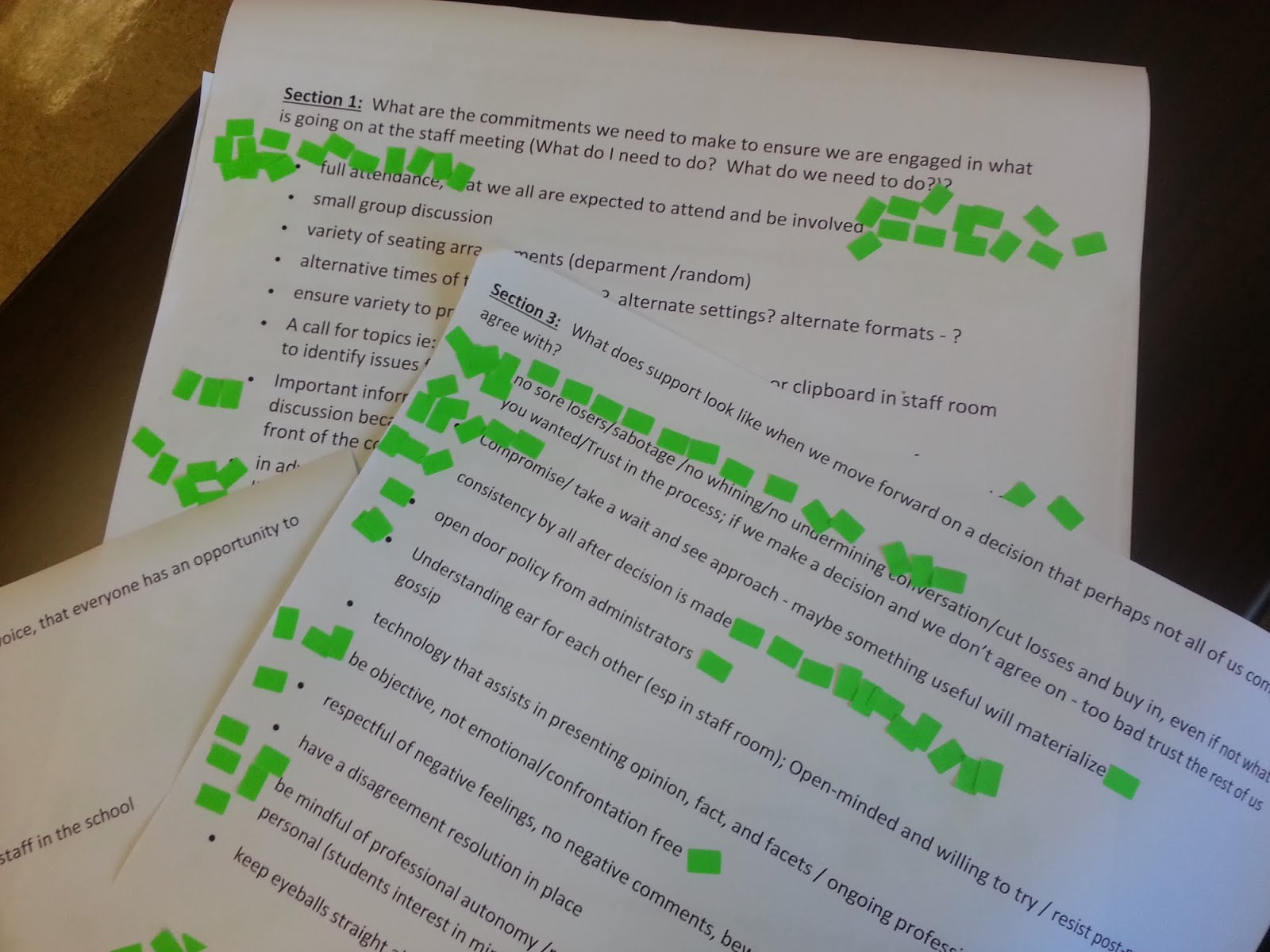
As a result of our work at that staff meeting, our Coordinator Group put together just such an activity--the 10 Dot Gallery Walk--which allowed our staff to interact with each other around the ideas for staff meetings that we had collected.  As a group, our staff were able to prioritize the suggestions and ideas in front of them for creating the norms of an inclusive staff meeting.  It looked like this:


The engagement of the staff in this activity was notable--people were asking each other for clarification, looking for similar threads on other sheets, and truly being thoughtful in the placement of their 'priority dots'.  And in the end, we got a product that gave us a distinct visual in terms of where the priorities of our staff truly were.  

But that wasn't enough.  

In order to continue to make this process authentic, we needed to take these priorities and craft them into a concise and easily articulated list of commitments that reflected the views of the group.  Again, it would be quick and easy for me to just put these into words that I thought represented the views of the group, but that would not be in the spirit of the activity (nor would it be terribly accurate).  So, as a Coordinator Group with representatives from each department, we began to sort and collect similar terms that were the highest priority for staff (denoted by the dots) and find themes.  The group came up with three temporal themes for staff meetings--Pre-Meeting, During the Meeting, and After the Meeting. Then, I became the scribe, the group became 10 'muses', and we thought with our mouths, debated, wordsmith-ed, re-wrote, and teased out 10 commitments.  They look like this: 

Pre- Meeting
  • we will submit items to the agenda, read the agenda and supporting documents prior to the staff meeting
  • we will attend the meeting and be engaged and involved
  • we will clear purpose and agenda to each staff meeting
  • we will have food for the meeting

During the Meeting
  • we will maintain a light, positive tone with a spirit of collegiality
  • we will come to the meeting with an open mind and consider new ideas and points of view
  • we will have the parameters of the decision-making process will be clearly articulated prior to the discussion
  • we will respect that there may be a need for additional time/input about a decision
  • we will use a variety of creative solutions (ie. anonymous votes, small group forums) to ensure each staff member has a voice

After the Meeting

  • we will trust in our collegial decision-making process
  • We will honor the decision made at the meeting and move forward!

But we are not done yet!  At our November staff meeting, each member of the group will present one of these commitments to the staff and talk them through how we got to that particular commitment from the original, gallery-walk document.  Once we have done this for each of the bullets above, we will ask the entire staff for any further refinements that need to be made.  At the December staff meeting, we will unveil our commitments to each other so that staff meetings actually honor the vision that we have collectively articulated.

From the outside, what we have done here might seem like a long and arduous process.  I guess I could have just made up some commitments and said this is what I want, what I expect.  Or I could have grabbed a list of norms from a book or article, and had us modify them to work for us.  That would have been much faster.

But this is not a race.  With something as important as how we will work together in a large group setting, faster is not better.

I think it has been time well spent.  The product that we are creating is authentic and representative of each of us:  through the tasks that we have done, we have been required to participate in the process, we modeled and used higher-order thinking skills, we are implementing a tangible product, and we have even touched a technology that we can use in our classes in the process.

Sounds a lot like what we set out to do in the first place, and I look forward to the final product.  I am very proud of our teachers for working through this--congratulations to our staff!