Wednesday, February 25, 2015

Instructional Rounds at Sa-Hali

*Note - this is not the standard '1000 words or less' blog post--Rounds are too much to describe in 1000 words :)

Last week, our school hosted 24 teachers, administrators, and district staff to do Instructional Rounds at our school.  Over the past two years, I have been fortunate enough to have be trained to do Rounds at Harvard and facilitate the Rounds process in schools in Canada and the US.  However, last Thursday was different: for the first time, I was on the 'other side' of Rounds as the host Principal. Over the course of the weekend, I had a chance to reflect on Rounds at our school.   As well, I received some questions about Rounds from the great group of administrators that I worked with in Langley on Saturday. As a result, I thought I might try to give a picture of what Rounds looks like and feels like from the perspective of an 'insider'.

Before Getting Started: Don't DO Rounds.
The process of Instructional Rounds is not something schools or districts should "do".  When people ask "How can we get Rounds into our school/district?", I usually answer with another question like "Why would you bother with Rounds?".  The answers usually involve phrases such as "it would be good for our staff", or "we are looking for some way to see what is going on in our classes", or, "we need something to bring meaning to collaborative conversations".  And while ideas like these these may constitute some of the positive side-effects of a school going through the rounds process, they are not reasons to "do" Rounds.  Schools and districts need to "use" Rounds because the end goal of Rounds is not to "do Rounds": the end goal of Rounds is to help a school or a district adopt a learning stance to solve an instructional issue they have been unable to solve.  In Rounds, this is called the Problem of Practice (POP).

Developing the Problem of Practice
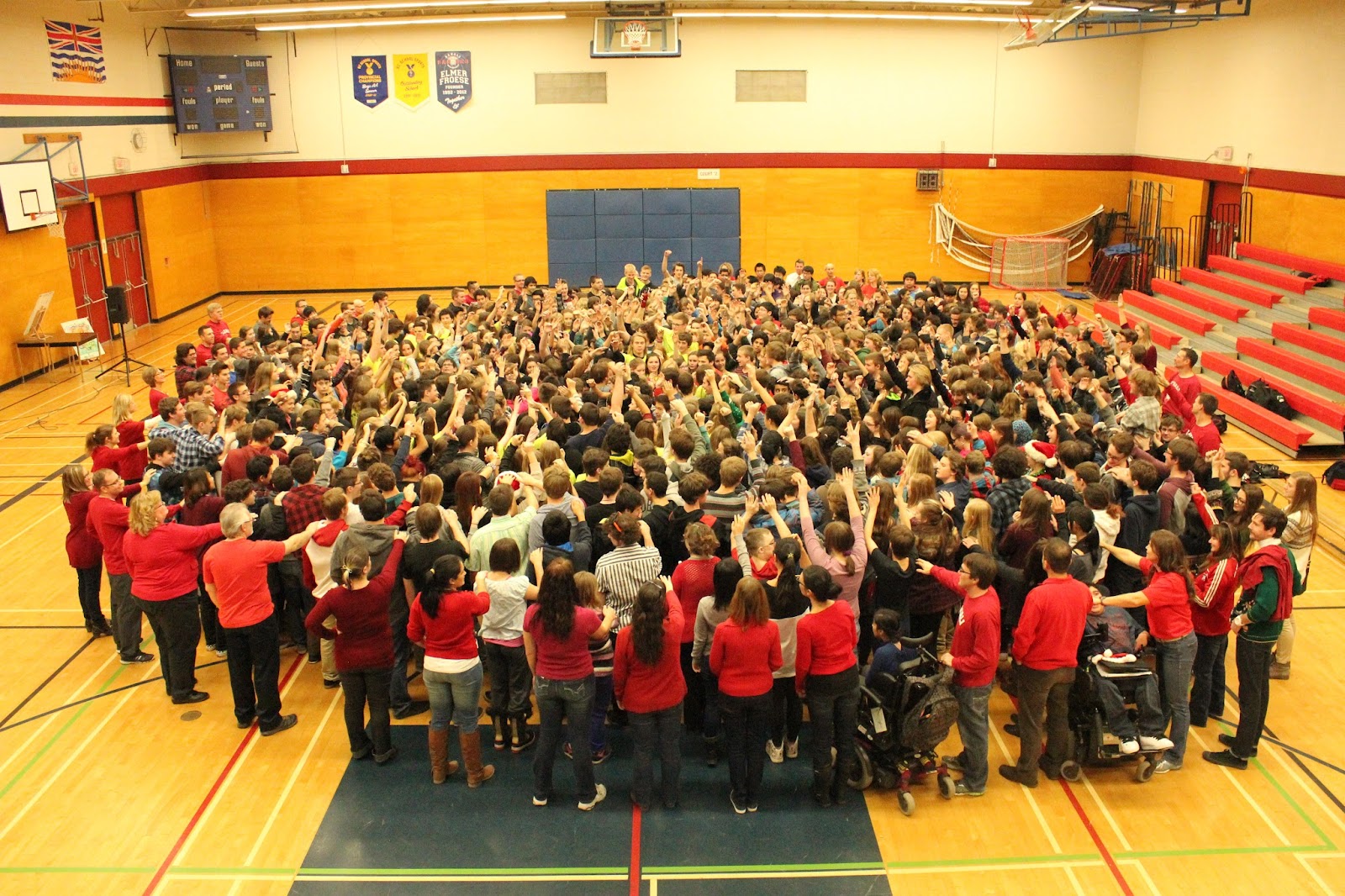
Our Attributes Assembly - Kicking off CCR!
Our school began this process more than 15 months ago. We began by using 'the shortest question possible', which for us was "Are we preparing our students for life beyond Sa-Hali Secondary?". From that discussion (and dozens more), our staff found that we needed to determine, define, and develop our Attributes of a Graduate, which culminated in our co-created Sa-Hali Attributes Assembly and resultant Attributes Survey of our students and staff.  From these surveys, our students and staff told us that the of the three attributes of creativity, collaboration, and resilience we needed 'to work on right now' was resilience. And so, the driver came for our Problem of Practice, which looked like this:

"Anecdotal data from staff indicates that resilience, particularly academic resilience, is the area where our students struggle:  when faced with tasks that involve multiple-steps or skills, students frequently look to the teacher for help rather than overcoming challenges to solve the problem themselves.   Survey data showed that nearly 70% of our staff were neutral or felt less confident that they were intentionally teaching resilience, or whether the tasks they were assigning to students required them to demonstrate resilience.  
At Sa-Hali, we have defined ‘academic resilience’ as persevering, advocating, taking risks, and utilizing resources to overcome adversity, stress, challenge and/or pressure to successfully meet outcomes in an academic setting."

From that point, we needed to define resiliency in each of our content areas in terms of what students and staff would be doing, saying and writing, as well as to describe the types of tasks that required students to be resilient.  And as a result, we co-created a POP with definitions and examples that would tell an external Rounds team where we were at and what we wanted them to focus on when we invited them to our school.

The week before Rounds:
The Principal of the school does not typically facilitate the Rounds day of their own school--the host school works with an external facilitator (in this case, another Kamloops Principal, Jake Schmidt, who had been trained in Rounds).  During the week prior to hosting the visit, I chatted with Jake a great deal about the make up of our groups, classrooms, length of observation times, and any other details for which I might have needed a sounding board or some different thoughts.  In developing a schedule for observations at our school, I had asked for volunteers who would be willing to have their classes observed by a group of educators from other schools.  I was amazed at the positive response--we had more than enough volunteers who were wanting to have our external Rounds team come in to a diverse cross-section of classes.  Junior classes.  Senior classes. Core academics. Electives.  And seeing that we had 24 educators coming to do 80 minutes of observations at our school, we knew we would get a great snapshot.

It was important to ensure that our group of 24 observers was trained in classroom observation, so I gave a 90 minute session in the week leading up to our visit on things such as 'learning to see, unlearning to judge' and the 'ladder of inference' (from Rounds training).  We also did some video observations to hone our ability to look for observation data specific to our Problem of Practice.

In order to do a final check on Problem of Practices created by schools using Rounds, our district created a 'Problem of Practice Tuning Protocol' (inspired by and loosely-based on the High Tech High Tuning Protocol) so that schools could bring their POP to a large group to 'tune' it.  This process was designed not to change the POP for the school, but rather to modify or deflect it so the POP gives the host school the best data possible.  This was powerful for me--we got specific feedback and helpful questions from the tuning group that concentrated our POP in to a much tighter lens to help our external team examine resiliency for us.

I also felt it was important to send a welcome out to the team who was coming to help us: we wanted to give them information about our POP and our context, as well as logistical things such as parking, start times, where they would be working for the day, lunch, and answers to whatever other questions they might have.  But most importantly, we wanted to let them know how excited we were to have them come to Sa-Hali!

The night before Rounds:
Wednesday night involved a lot of running around--I was gathering post it notes, markers, chart paper, tables, chairs, projector, laptop, school maps, groups, and whatever else the team might need to observe, make patterns, predictions, and provide us with direction about the next level of work. Having learned from the outstanding organization of logistics at Richland Middle School in Fort Worth, I have seen the importance of making sure this 'little stuff' is taken care of prior to the day--it just makes the process run much more smoothly.
The Rounds "table toolkit" from RMS - a good exemplar! 

The day of Rounds:
The team arrived at 7:30, and after a quick meet and greet, we got started at 7:45.  Our facilitator talked for a bit about the day, and then I reviewed our POP.  I talked about the process our school used in developing our POP, our definition of resilience, and some 'look-for' focus questions for the group.  I also described the structures that we have in place at our school to support student and educator learning for their reference. After a few quick bits of organization and some norms for observation, the groups were off!

Each of the six groups did four 20 minute observations in four different classes.  So, just over 90 minutes later, the group came back, took a quick break, and started going through their observation data to find points that were clear, descriptive, non-judgmental, and relative to our Problem of Practice.  Using post-it notes, they presented those data points to the other members of their group to vet them, and then they began to organize their observation post-its on chart paper in a way that would allow them to develop some patterns.
Making patterns from observation data

At this point, at the suggestion of Sara Bruhn (one of the authors of Instructional Rounds who was with us on Thursday), we did something a bit different.  We brought an internal team of seven teachers from our school into the process: they came in to help the external team make some predictions based on the question "If students did everything that they were asked today in the classes that you observed, what would students have learned?".  Our teachers were also there to help the external team to create the 'Next Level of Work'-- a set of plans that our school could design and implement going to help us with our Problem of Practice.

I have a hard time describing the dialogue that took place between our staff member and the external team.  I was actually shaking my head in amazement at the extraordinary depth of the conversations, the talk about pedagogy, the analysis of tasks that were observed, and the level of professional curiosity that each of the educators in the room had about the practice in our school and their own practice back home.  There were teachers, administrators and district staff working side by side, asking questions and respectfully challenging each other with things like (and these are a very thin slice of the examples)
Grinding through the data--rich dialogue!
  • "What did the student do that made you think that?", or 
  • "Did that task require resilience?  What was our evidence of that?", or
  • "I agree with you, but how is that related to the school's Problem of Practice?"
  • "If we asked the school to design and implement this, would they find it useful?", or
  • "Wow, I really want to go back to my class and look at what I'm doing in my classes."
And in the end, our internal team saw the creation of thoughtful, evidence-based patterns and cross-pollinated ideas that we can work on with our staff to move us towards our goal of solving our Problem of Practice.  All of this carefully and thoughtfully prepared by 24 professional volunteers through an accumulated 30-plus hours of observation.

Wow.  

After a lot of thank yous, hand-shakes, laughter, and pats on the back that I find comes from a day collective hard work and struggle, our facilitator, Sara and I debriefed on the day.  We chatted about things that we could have changed, timing, groupings, and anything that we could think of.  I also shared the feedback that I had already received from a couple of our staff members who were observed that day:


"Nervous at first but then settled in. My students (Grade 12s) also said at first it felt a bit weird (like they were being judged) but then they hardly noticed. I liked that the observers talked with my students...kind of wished they talked to me a bit more :) "

'The students really weren't phased by having the observers in the class.  I would say they were better behaved, though.  :)  As for myself, even though I wasn't being marked or judged, it still felt stressful.  Maybe after a few more observations that will subside and I can teach more naturally, but it felt a little forced at times.  The observers were excellent as well - very respectful."

"It was a great experience. Some students felt intimidated at first, but gradually warmed up to the process. They said it was cool and would do it again."

We chatted for a bit longer, I made a pile of notes, and the day was done.  And everyone was exhausted (or at least I was)! 

Looking forward to our upcoming faculty meeting this Monday, we are going to try a different method of working through the data with our staff, and we are confident that a number of the suggestions we got from our Rounds volunteers will help to shape where we want to go relative to our vision.  I will post about that next week, so stay tuned.

In summary:
Rounds continues to be the most powerful learning experience that I engage in as a Principal, and I only wish I would have been able to do it when I was teaching.  As a participant, as a facilitator, and now as a host administrator, I have seen the learning that has taken place by the observation team, the internal team, and the host school.  I find the process of Rounds to be unique and transformational in its ability to focus people on a specific problem.  If you have an instructional challenge in your school that you would like a new set of eyes to look at, Rounds might just be a mechanism that works for you!


Cross-posted at the Sa-Hali Educational Sandbox

Monday, February 2, 2015

Authentic Accountability

New Year's Resolutions are always interesting to me. Typically, I would make a whole host of lofty proclamations on December 31st to a few vaguely interested peers who themselves would be unlikely to repeat a single one my goals more than three minutes later.  For a few days or perhaps even weeks after I might pull the kids' snowsuits off of the treadmill, eat quinoa every meal, and drink sixteen cups of water a day in an attempt to squeeze into clothes that I purchased at a time when I believed the scale in the bathroom was much more accurate than at present. However, after a few weeks, much like the resolutions that I had made to a couple of buddies, my efforts would fade, and I would be right back where I was prior to the start of the year.  Pass the cured meats, please.

Just prior to the Christmas Break, our school made a type of 'resolution'.  After months of our faculty working hard to co-develop our "Attributes of a Graduate" , we developed our driving question to help us move our attributes of collaboration, creativity, and resilience (CCR) at our school from theory to reality.  Our question was "How do we get these attributes into the heads, hearts, and hands of our students?".

After our staff did a ton of initial planning at the December ProD, we also had to confront a couple of realities for anyone in education:  firstly, anyone over the age of 30 is considered to be "old" to our students, and secondly, "old people" like us are basically incapable of understanding what kids would actually find to be "cool" in terms of a presentation such as this.  (That I have even used the term "cool" as opposed to "sick" or some similar term demonstrates my own nerdiness).  So, we created our own "Sa-Hali Project Tuning Protocol" modified from the High Tech High Tuning Protocol, and assembled six of our students to work with our presentation project lead team.  We wanted to go "soft on the people, hard on the content" to determine whether our presentation would in fact get in to the heads, hearts and hands of our students.

I cannot underscore this point more:  the power of project tuning with students is something that truly has to be experienced to be understood.  The comments and suggestions from students were thoughtful and honest, and at the end of the process, each of the students said they were glad to be a part of co-creating something for the rest of the student body.  The people in the room developed a bond that day and without question, the presentation was immediately better than it would have been. It was better not just because the participants had a student's perspective, but because they were people that had really good ideas and cared deeply about their school.  Awesome.

So, back to my bit about resolutions.  Once we began the project tune, we had crossed a threshold--suddenly, our staff had "outed" itself.  Figuratively, it was December 31st, and we were telling these six students that we were going to do something different.  And to put even more pressure on ourselves, we were getting them to help us find a way to make the other 775 students and all of their parents remember the fact that we were going to be doing something different.  That creativity, collaboration, and resilience were going to be our focus from this point going forward.  Uh oh.  Not so fast on the cured meats.

The hard work of our staff and students culminated in our first ever "CCR Attributes Assembly".  I won't lie, I was tremendously nervous.  Usually, assemblies were something to do with spirit, pep rallies, holiday celebrations, or messages from the community.  But this assembly concept was totally different, unique, and untested.  As well, while I was doing the introductory segment of the assembly, the rest of the staff had self-organized into three attribute groups that all had equal (and equally as vital) pieces in the show.  While I had helped with providing a framework for the other parts and our kids had 'tuned' them,  I had not actually seen what the groups were going to do.  Not to mention, each of them had a physical task for kids and staff to do that would reinforce the importance of our attributes. Inasmuch as I had referenced innovator Guy Kawasaki and his "don't worry, be crappy" mantra, and had told our staff we needed to get on with it, this was getting a bit crazy.  It was all on the line in front of 775 kids!  We couldn't walk away from this New Year's resolution--aka. #thisishappening

Together - Attributes.jpg
Our culminating symbol for resilience--WE will do this TOGETHER.
...and it all came together.  The whole school came together because we all did it together, for each other and in front of each other.  And it was awesome.

This process has made me question what authentic accountability really means.  As a staff, a lead team, and a project-tuning team, we were accountable to each other.  We were accountable to a highly visible product and a large and interested group.  But there were no grades.  No percentages.  No rubric.  There was no one giving us a thumbs up or a thumbs down.  There was just our own sense of pride in doing our best work for each other and for an audience because they were there, and they would be watching us.

We will continue to make ourselves accountable to each other, to our students and to our parents.  As much as we co-created this assembly to promote our attributes, to get feedback about these attributes, and to find out where our students and staff wanted to get started with these attributes, we also are creating our plan to develop these attributes that we will project tune with another group of students and parents so we can make our vision of a graduate become a reality for every one of our students.  And by creating our own authentic accountability checkpoints to eachother and to our community, we can avoid CCR becoming little more than a New Year's Resolution and keep ourselves on track to achieve our goal of producing graduates that are creative, collaborative, and resilient.

Friday, December 5, 2014

"Don't Worry, Be Crappy"

I have never blogged 'real-time', in the 'between slots' while facilitating a professional development session - a new challenge, so here goes!

Today, we had our December Professional Development Day.  The day was co-created and tuned by our PD committee, and was a continuation of our thread of Attributes of a Sa-Hali Graduate.  Now that we have landed on the attributes that we will be focusing on for the forseeable future, as a group, we wanted to start to provide some scaffolding to our staff about creativity, collaboration, and resilience.  Building upon our point of inquiry of "How do we get our attributes into the heads, hands and hearts of our learners", we developed the following learning goals for the day:
  • to have a better understanding of required elements for innovation to enable us to think differently about the possibilities for connecting our students to our attributes, and to bringing collaboration, creativity, and resilience to each one of our classrooms.
  • to make our thoughts visible about these attributes (why they are important, where they fit, and what will challenge us in making these attributes a part of our fabric) to the entire group, and to our school community through large, visual posters created through the process of the "chalk talk" protocol
  • to determine common language around creativity, collaboration and resilience through the development of 'elevator statements', statements that, when asked, provide a framework for each of us to describe what our school believes are the elements of our three attributes
  • to co-develop the kick-off assembly so that it can be tuned by our community through the lens of getting our students thinking about creativity, collaboration and innovation.
We started the day watching the amazing TED Talk by innovator Guy Kawasaki.  He had a 'top ten' list of things he felt were essential for innovation:
  • Make meaning
  • Make a mantra
  • Jump to the next curve
  • Roll the DICE
  • Don’t worry, be crappy
  • Let 100 flowers blossom
  • Polarize people
  • Churn, baby churn
  • Niche thyself
  • Perfect your pitch
He also threw in a final, 'bonus' bit of advice around ignoring "bozos" (and also described the different levels of 'bozocity' - a term that I am going to adopt).  And while you can watch the video to get his entertaining clarification on each of these tips for innovation, there were a couple that resonated with me as our school goes forward on the journey to bring our attributes to life in our school, classrooms, and learners.
“Make meaning” - while a large part of the purpose for our day today is to make meaning of our attributes for ourselves, Kawasaki was referring to the idea that we need to DO things that are meaningful--meaningful for ourselves, and meaningful for others.  He talked about how people who start into something to make money often aren’t doing something that is meaningful, and others start by doing something meaningful and as a result often make a great deal of money!  As a school we cannot simply tell students to be creative, collaborative and resilient in order to get a better job, to have a better resume, or some other external reward-style incentive.  We need to give students opportunities to do meaningful things that develop and utilize their skills of creativity, collaboration and resilience.
“Don’t worry, be crappy” - this is one that is so important for me, not because I wish for anything that we do to be crappy, but because it is ok to try something and for it not to go perfectly.  Mr. Kawasaki talks about how we cannot wait for every possible factor to fall into place before we move forward; with respect to our school, we need to get going, and not worry if what we start out doing is less than perfect.  In fact, I’m sure that we can end the mystery right now--no matter how we start with bringing creativity, collaboration and resilience into our school, classrooms and tasks, it WON’T be perfect.  But we need to continue to iterate, and iterate some more.  It is what we want our students to do, and exactly what we need to model.
As a staff, we then went to “attribute stations” where there was a short, priming video clip on creativity, collaboration, and resilience, followed by an article on each, and then “Chalk Talk”, where teachers silently wrote down and doodled their thoughts, hopes, dreams, and challenges around
"Chalk talking"
implementing changes to their classes that would develop our attributes.  This was powerful for me--educators silently making their thoughts visible, and others commenting on those thoughts, adding to them, and providing different perspectives--all in a non-threatening and safe environment with their peers.  No one dominated the conversation, because the ‘conversation’ took place without anyone ‘speaking’.  Once this was complete, each group ‘carouseled’ to the next attribute, and continued the chalk talk from the previous groups that had been there.
To close out the morning, we co-created and co-edited our “Elevator Statements”.  Using Google Docs and the comment feature, we had each group create statements that thematically summarized the thoughts of our staff on each of the attributes in separate classrooms.  As they did this, the other groups would go “soft on the people” while being “hard on the content” to make edits and iterations to each other’s elevator statements so the true feelings of the group would be heard.  (As an aside, it is always amazing for me to see these tools in action, and to see the virtual editing that can take place to push us to create a product that more resembles what we had hoped for).  In the end, each of the groups presented to the large group.  Interestingly, the presentations of our “Elevator Statements” likely would have required an elevator to the moon--they were long and complex!  We realized that while each of us now has a better feel for our attributes, there is still more to do in terms of clarifying our thoughts for the greater school community.
After lunch, we split into a new set of groups to get to work on our attributes assembly.  With the mantra of “Hard Work, Together”, our group used a google template to develop our “to do” list for our upcoming student assembly.  At this point, there was dialogue about whether we were going to be able to pull our assembly together.  There were those who wanted to get going with it, as we have spent a great deal of our time over the last 16 months discussing our attributes and leading up to this 'attribute launch'.  There were others who felt that because we have spent so much time and effort to get to this point that we want to make sure we do it right, because we don't want our presentation to fall on its face.
To which I injected Guy Kawasaki's statement--"Don't worry, be crappy!".
We want our kids to take risks, to try things, to really get behind something and put their all into it.  To be creative in making it.  To collaborate to make it better.  But most of all, we want them to try something, and whether it works out or not, we want them to try again, to iterate, and demonstrate their own resilience.
If we want kids to do this, we too have to model it--to be unafraid to 'be crappy'.  And so, we will go forth.
Overall, it was a very productive day for us, and while our end product for this phase of the rollout may not be perfect when all is said and done, we will iterate, and try again! 


And not worry!

Tuesday, November 18, 2014

Inquiry-Based Discomfort

Over the last several months, our faculty has been working hard to co-develop our "Attributes of a Graduate".  As a group, we wanted to determine the skills and characteristics that we want for our students to have as they leave us to face an ever-changing and uncertain future.  We had come up with a number of descriptors as a staff, and solicited thoughts and input from our parents and community.  On our Professional Development day this past Monday, we determined our critical question to drive our learning for the day was  "How do we get Sa-Hali attributes into the heads, hearts, and hands of our students?".

This question led us to consider a number of things:
  • What are the most important attributes?
  • How can we demonstrate that students have an authentic voice in attribute creation and development?
  • How many attributes will students (as well as the staff and community) be able to focus on and remember?
  • What is the best way to kickoff/promote our attributes, and truly get them into the heads, hearts and hands of our entire Sa-Hali community?

So the day began, and were I to use descriptive, non-judgmental, instructional rounds-style data to describe the day, I might say the following:
  • the staff participated in a team-building activity focused on our collaboratively developed attributes
  • the staff did a distillation and consensus-building process that required them to analyse, evaluate, synthesize and then agree on three "Attributes of a Sa-Hali Graduate" that will guide our School Innovation Plan
  • multiple staff members led these small group discussions to engage all of our faculty and ensure each staff member's voice was heard
  • when I asked the staff to take a break for coffee, none of the groups left their tables to take a break--they just kept working on the task in front of them (they eventually left a few minutes later, but I had never seen that before) 
  • the staff used collaborative technology to crowd source ideas
  • the staff began collaboratively planning a promotional campaign (perhaps something that takes off from a creation by two staff members at our school) to showcase and co-develop our attributes, including a mixed media assembly and follow-up lesson plan to solicit input from our students
If one read the above observational data, they might say that it was a productive day that had our staff participating in higher order tasks.  And, going 'up the ladder of inference', I can tell you that without equivocation, it most certainly WAS a productive day.  Yet at one point, one of my teachers said to me "Why are you frowning? You should be really happy right now--look around!  EVERYONE is working on this!"

Good point.  Why was I frowning?   

I wasn't frowning because I was upset--quite the opposite, in fact.  Our staff took a very important task and ran with it...and they ran hard! I was frowning because a process that I had envisioned being a bit more linear and sequential went 'wide' in a short period of time.  Very wide.  And the number of amazing ideas flying around the room suddenly became overwhelming to me.  Too often in my time as a Principal, I 'knew' what the final product should be.  I would begin with that product in mind, be hyper-organized in my planning, and guide the group to a point which would look awfully similar to MY vision--sometimes with only scant bits of commitment from everyone involved.  I would utilize very little of the knowledge and expertise of the room, other than to validate my own ideas.

#bigmistake

By starting with an inquiry-based mindset on Monday, the critical question rapidly moved us into a level of divergent thinking that I had completely underestimated.  I quickly realized that my role in the room had changed significantly:  I was going from 'leader' to...well,  learner, facilitator, cheerleader, and even 'granny' (from Sugata Mitra's 'School in the Cloud').  And while the level of engagement and discourse amongst our faculty was astounding, the level of complexity in terms of coming up with a solution to get our attributes into the heads, hands and hearts of our students had also increased dramatically.  Hence the frown.  And when that staff member saw me frowning, I'm sure I was overwhelmed and all-consumed with one thought:  "How the heck am I going to pull all of this together?".

Later Monday evening, I received a very thoughtful and kind note from one of our staff members. They were impressed with the thoughtful dialogue and discourse that took place throughout the day and the amount of headway that we had made with our attributes.  And then it hit me: it's not about how "I" alone will do this--it's about how WE will do this together.  I can only guess that had I used my traditional method of 'asking a question that I already knew that answer to', I would have gotten 'my answer', and likely been mostly on my own trying to figure out the best way to make it a reality. But by using a co-developed driving question that engaged the group, WE got 'our solutions', and with that ownership, WE will transform our solutions that we created into reality TOGETHER.  And WE will do a fantastic job because the product that we create will be visible to our students and our entire Sa-Hali community.

As successful as the day was, my reflections about Monday have also made me realize that if I was out of my comfort zone and overwhelmed by the divergent thinking of our group and my changing role in the learning that was taking place, others might experience this too.  Going forward, I need to be very cognizant of the fact that as we look ahead at the journey our school will take to help our grads to become creative, resilient collaborators (our three attributes that we are going to present to our students), many of us may be moving of our individual and collective comfort zones.  When we develop tasks and activities that truly require students to demonstrate our attributes, each of us will need support in working through learning that is non-linear, messy, and requires us to become a combination of learners, facilitators, cheerleaders, and 'grannies' all at the same time!

But if the net result of these tasks and activities that we co-create is the engagement and learning that I saw from our faculty on Monday, it will definitely be worth the initial discomfort that comes with inquiry-based learning.

*Cross posted at The Learning Nation

Monday, November 3, 2014

Connecting the Disconnected


On October 24th/25th, I was lucky enough to go to the 21st Century Learning conference in Vancouver, BC. I was particularly jazzed to see two presenters; Will Richardson and my pal Bill Ferriter have both impacted my thinking significantly since I added them to my personal learning network.  And while their methods were different, both Will and Bill had some common messages in terms of the learning that students are doing in schools today and how (or if?) it relates to the types of skills that students will need in the hyper-connected environment that we live in today.  They pushed the group to think about how we 'connect the disconnected' by highlighting a some points that resonated with me:

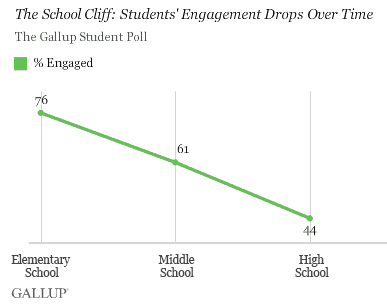
As kids move through the K-12 system, they become less and less engaged in their schooling.
And while Sir Ken Robinson and others have affirmed this fact for us, both Will and Bill quoted the 2012 Gallup Poll Student poll (of more than 500,000 students) that showed the percentage of students that described themselves as being engaged in their studies dropping by over 30 points as they move from elementary to high school.  Each of them challenged the group:  are we comfortable with this?   Are we willing to confront this?  And for me personally, no matter how many times I hear statistics like this, I still cringe and think about what we can do differently.


We need to give students meaningful work
Students want to do something that makes a difference.  They want to help others.  The Kiva Club developed by Bill Ferriter's Grade 6 that raises money to provide microloans for impoverished individuals and the #sugarkills blog to fight obesity that his students created are sustained by students who are willing to give up their own time to help others that they have never and will likely never meet.  But worksheets are not meaningful.  Memorizing answers to questions that we can simply search for using Google are not meaningful. Right now?  Meaningful.  There is a chance you might need to know this at some point in your life?  Well, not so much.

Classrooms need to be places to make connections, not disconnect
We can no longer ask students to disconnect from the hyperlinked, information-saturated, teacher-laden world (yes, teacher-laden--because students have the ability to learn so much from virtual and face-to-face peers and adults in their world who have loads of expertise in different areas) where they learn for two-thirds of their day.  As Will Richardson said, we need to completely wipe that scarcity-inspired thought from our minds.  We have to.  Because if we think that students are going to settle for anything less than that, they won't (and they aren't).

We MUST have a clear vision
We don't begin with 'all of our students are going to blog'.  Or 'each of our classrooms will have Smartboards'.  Or spending a billion dollars on iPads (as the LAUSD did, with decidedly 'mixed' results).  We don't begin with the mindset that 'technology engages kids'.  We begin with a vision of the attributes that we want for our children (like the excellent work being done in the Kelowna School District and Farmington High School), and then use these attributes to guide our decisions, our structures, our PD, and our approaches to student learning in our classrooms.  (To see a way to get started with your staff, check out this fun way to begin the conversation about developing a mission in schools.)

So, I know what you are thinking:

"Ya ya ya...we know all this stuff, but how do we do it?

Both Will and Bill were very clear--in British Columbia, we enjoy freedoms in our curriculum that simply do not exist in most jurisdictions across North America.  And they were also very clear in their plea for us as educators to take advantage of this curricular latitude to create the learning environments that children need.  And finally, they both told the participants one thing:  get started.  Now.  The urgency lies in the idea that every day the world is changing, so we have a moral imperative to change the environment that students learn in for six hours per day to more closely mirror the world they live in for the other eighteen hours.
So at Sa-Hali Secondary, what are we going to do as a result of the message that I heard this weekend?

  1. We are going to involve our students in the development of and execution of a process that will both highlight our work on attributes to this point and involve them in the selection and definition of these attributes.  We will use the High Tech High Tuning Protocol to develop this process starting with the question "How will we involve our school community in the development of our list of attributes so that they are in the heads, hearts and hands of students, staff and the community?"
  2. We are going to use these attributes as a start point for the process of Instructional Rounds in our school.  We will reflect on our school through the lens of the attributes that we feel are important, and determine how we can scale the innovative practices that are currently happening in our school through making the walls of our classroom permeable to our staff and to others.
  3. We are going to make student and adult learning visible at our school through the development of a school-wide digital portfolio.  Our staff and myself will learn the process of developing digital portfolios by creating a three-dimensional digital portfolio that will serve as our school improvement plan.  We will do this so that we can learn by doing, and model the creation of a positive digital footprint that will allow students to truly demonstrate what we know.  This will allow us to prepare students to develop a capstone project as a culmination of their K-12 learning (a great example of Capstone Projects can be seen at Chris Lehmann's Science Leadership Academy) that they can take away to support them in what they choose to do after they leave us.
  4. On a personal note, I am going to start a Kiva project at our school.  I don't know how this is going to work yet, but I am confident that like every school we have the students who want to make a difference in the lives of others.

Perhaps these are lofty goals, but I am articulating them here so I can hold myself to them.  I agree with Will and Bill, we can change how we engage and empower students in their education, and we need to start. Now.

So we will!  Stay tuned.

Cross-posted at The Learning Nation

Wednesday, October 22, 2014

Advantages, or Opportunties Lost?

The number of students taking online courses in British Columbia is growing.  And while this growth has slowed slightly in the last couple of years, the impact of the rapid increase from 30000 to nearly 80000 unique students taking one or more courses from BC distance education facilities is something that I have begun to notice at our school.  Our district is no exception--for example, more than 300 students were taking online Physical Education last year.  And while it may seem paradoxical that students are taking a physical activity course on the computer, it is happening.  And not just in PE.

To be quite honest, when asked, I have been cautious about recommending online courses for students.  I have always felt that the online learning environment can be effective for certain students, but for others, online courses can be much more challenging to complete.  I have always felt that a 'regular' classroom is a better place to learn than in an online environment.  

I fully acknowledge that I have a bias: I am a product of the public school system, I work in the public school system, and my children are in the public school system in typical, 'bricks and mortar' classrooms.  For all intents and purposes, the public school system has served my family very well.  But the reality is that more students are finding alternative ways to explore their passions and get credit for it at the same time, and as a result, those students are moving away from the traditional 'bricks and mortar' schools.  I also acknowledge that my experience in an online learning environment is limited--I did the Deeper Learning MOOC last year and got a great deal from it.  However, even with the scant evidence that I have to support my feelings--I feel the in-classroom experience has some decided advantages for kids.


Bearing these thoughts in mind, I began pondering a question: 


"What are the advantages for a student in a typical, face-to-face, 'bricks-and-mortar' school versus an online learning environment?"


I have asked a number of colleagues this question, and even posed the question in a survey on Twitter.  Here are some of the more common answers came back to me:

  • interact/work with others in a face-to-face environment
  • more 'immediate' interaction with a teacher and other students
  • someone there to motivate, inspire, and 'drive the learning'
  • getting to hear the ideas of others
  • a diversity of hands-on activities
  • being a part of a culture, something larger than the individual
  • student-student relationships
  • student-teacher relationships
And while there are likely numerous other pieces that we have not considered (and please feel free to add them to this survey), I want to evaluate each of the advantages above, but focus in on each of them with a slightly 'tighter' lens, which is

Are we consistently leveraging the advantages that we say that we have in 'bricks and mortar' schools?  Considering each of these advantages, if evidence to support these factors is difficult to find on a consistent, classroom-to-classroom basis, then these are NOT true advantages that we are leveraging. Instead, one might argue that they are little more than lost opportunities.

So here we go, let's examine them, one-by-one...

Interact/work with others in a face-to-face environment:
Working with others in a face-to-face environment is a skill that has been both deemed as necessary and condemned as being lost with today's student, all in the same breath.  And while there are certainly more jobs that can be done 'remotely' or from behind a screen, the majority of jobs and interactions that students are going to have in the next few years are still going to require face-to-face interactions and cooperation.

But ask yourself this....

What are the nature of the interactions that are taking place in classrooms?  Are students actively taught how to effectively collaborate in partnerships, triads, small and large groups? Are there driving questions and opportunities for kids in the class to dialogue and practice these skills?  Are the tasks that students are asked to do requiring them to participate and interact with each other?   Are the tasks ones that require positive interdependence between the students, or for them to simply to do their part? Is the seating arrangement in the classroom conducive to these sorts of conversations?  Is the length of time spent on these interactive activities long enough for students to become proficient at these skills and make them transferable to other situations?  

Someone there to motivate, inspire, and drive learning:
Each of us has had those teachers who were truly inspirational, that got to know us, and got to know what our strengths and interests were both in and out of the classroom.  They took something as boring as Ohm's Law or poetry and turned it in to something that was both interesting and meaningful.  Their passion for their subject area was second only to their passion for us as students in the classroom. They kept us on task and roughly moving in the same direction.  It was awesome.

But ask yourself this...
What percentage of your teachers or university professors fit the above description?  100%?  10%?  1%?How many of them tried to determine what motivates students to learn?  In our schools, do we ask students what their motivations are, or do we assume they are driven by things like grades, university, or the promise of a better life (which may or may not be so applicable to a rambunctious Grade 7 boy who has just come in from the playground)?  Do we ask driving questions (check out the 'Tubric' from the Buck Institute), and use tuning protocols to empower students in their learning, or do we come up with the activities in isolation, and hope that students want to do it? Do we think of learning from a  developmental perspective, honoring the fact that if we create our lessons with the acknowledgment that students come from different backgrounds and have different skill sets, that they will be more motivated to do the task? Do we try to determine what gets students into 'flow'?

If we don't do these sorts of things to inspire our students, we cannot lay claim to having someone there to inspire and motivate as an advantage--we can only lay claim to having a person...well...there.

Getting to hear the ideas of others:
There is no doubt that crowd-sourcing an issue is going to lead to a more diverse set of solutions.  Among many examples, Steve Johnson's "Where Good ideas Come From" talks about the collision of smaller hunches to form bigger ones, and the Professional Learning Community model of collaboration both point to the power of the group versus the individual.

But ask yourself this...

Do we consistently give students tasks that require multiple perspectives and multiple solutions?  Do we actively demonstrate to our students that there is more than one way to accomplish a task or meet a learning outcome?  Do we 'go wide' with our students, asking the shortest question possible and then encourage divergent thinking?  Do we create a safe forum for this to occur, and have students display their learning in such a way that it allows others to comment on, critique, and draw inspiration from to affect their own work in a positive way?

If we have students do tasks that require one answer or that can be copied from a book/website/peer or have students demonstrate their learning in ways that are not visible to their peers, this cannot be considered an advantage.

A diversity of hands-on activities:
Individual work.  Group work.  Driving questions that require creative solutions. Peer review and evaluation.   Labs.  Projects.  Role plays. Digital portfolio work.  Video creation. Connections with the community.  Field trips.  Internships.  Cross school/district/country collaboration using technology.    The list of possibilities goes on and and on for activities to do in the classroom with students.

But ask yourself this...
What are the typical tasks that students are required to do in each of the classes in our schools.  I can say with honesty that some of my science classes were predominantly textbook based, with the 'where's Waldo'-style review questions at the end of a section, potentially a lab, and then some sort of quiz or test.  Occasionally I did a debate, role play, or something that I thought was pretty cool (although I am not completely sure that the kids agreed with me). However, for the most part, I felt as though I had a great deal of content to get through and didn't have a lot of time to 'waste' on these sorts of activities.  I rarely did any task analysis to see what my students were actually required to learn as a result of doing the tasks in my classes.  Looking back, I could have truly empowered my students in their learning by having them involved in task development:  I could have used a variety of different activities that would have been designed with a focus on  'how best will students learn this' rather than 'how best can I cover this material'. 

If students are mostly exposed to textbook/worksheet based tasks with quizzes and tests that are multiple choice, matching, short answer and long answer questions, we are not maximizing our opportunities to engage kids with the activities that are possible in a face-to-face environment.

More 'Immediate' Interaction with a Teacher and/or other students
For a variety of reasons, students in an online environment may experience a 'lag' in terms of needing versus getting assistance.  And if the online experience is such that a student is working individually and asynchronously, the odds of the student being able to work with their peers can be 'hit and miss', depending on who is online or whether such a mechanism has been set up with that particular course.  In the 'bricks and mortar' classroom, the students are in physical proximity to the teacher and eachother, and most often are learning synchronously.

But ask yourself this...
Can the student access the teacher at any time, and if content coverage is a norm, is there even time for students to get help from a teacher?  And if not the teacher, are there mechanisms for peer support that have been created and actively taught in the classroom so that students can get this 'immediate' interaction?

Being a part of a culture, something larger than the individual
Friday night football, Texas-style.
Last year, I got to cross off a 'bucket list' item when I was able to go to a Friday night, high school football playoff game in Texas.  The kids were there in school colors.  The parents were there in school colors.  The marching band was there in school colors, playing the school song.  The home town was there.  The visiting town was there.  Everyone was there.  I got goosebumps just sitting in the stadium, thinking that I was a part of something amazing--even if I wasn't from Texas.  

LINK Crew - Day 1!
Of course it's not about football, it's about that connection to the school, the colors, the mascot, and the community.  To be a 'Sabre', a 'Dragon', or a 'Bulldog' right along side of the rest of your peers.  But if we don't consciously and consistently create opportunities (like LINK Crew, peer mentorship, spirit days, intramurals, recognition assemblies, etc) for our students to connect with our school and the people that work there, they are not a part of something larger than themselves.

Student-Student Relationships:
Students love to come to school to see their friends and socialize.  They love to work with each other in class, and play with each other at lunch.  

But ask yourself this...
As schools, do we cultivate these relationships, and ensure that they are positive and productive?  Do we have programs such as Me-To-We, RespectEd, Roots of Empathy, and Safe Schools.  Do we monitor our progress and how students are feeling about our schools through Student Voice, Satisfaction Surveys, tools like Tell Them From Me, and focus groups.  And when we get this information from our kids, do we respond to it so they feel better about connecting with each other and the school.  Or do we hope for the best, and allow the "Law of the Jungle" (a tongue-in-cheek quote from one of our excellent staff members) to manifest itself in our hallways with a "they need to sort it out" philosophy?  

While this area is not a dichotomy, we need to help students with developing positive relationships with their peers.  Adults need help with their relationships all of the time--why would kids be any different? 

Student-Teacher Relationships:
This could be the biggest leverage point of all for bricks and mortar schools!  Research validates the statement that kids 'don't care what you know until they know that you care'--in fact, the teacher-student relationship has seven times the impact than does the teacher's knowledge of their subject area.  What an advantage, right?

But ask yourself this...

How are we getting to know our students, or are we really getting to know our students at all?  Would our students say we have positive student-teacher relationships in each of our classrooms? Considering there is a repository of ideas only a few mouse clicks and key strikes away for getting to know our students, do we use these sorts of activities to create connections between ourselves and our students?  How do we determine the prior learning and individual contexts of our students?  Do we believe in that respect is something that is earned, and therefore that we must earn the respect of our students and their parents?  Are we vulnerable in front of our students, and comfortable telling them that we don't have all the answers, and it's ok?

If we do not actively cultivate these relationships, we have lost one of the very biggest potential advantages of a 'bricks and mortar' school.  


In conclusion, I want to add one big qualifier--each of our schools is doing many of the things above, at the least in smaller pockets, and sometimes full-scale.  And should we leverage each of these opportunities that we have with children in our schools, there is no one who could convince me that the online experience would be superior to the in-class experience for student learning.  Yet given the proliferation of students choosing alternative options to pursue their passions while concurrently getting credit towards graduation, I think all 'brick and mortar' schools need to take a sincere look at each of these opportunities for us to enrich the in-class environment to see whether they are truly advantages that we are realizing rather than tremendous opportunities that are lost.


This has been cross posted in the Sa-Hali Educational Sandbox.

Friday, May 23, 2014

Working with High Tech High - Part 1

Several months ago, we hatched the idea of a school of unique and innovative teaching and learning.  The driving vision for this school is “Sa-Hali Secondary School will be an exemplary learning environment for students, teachers, and future teachers. Through innovative educational practices, we will design and implement meaningful, problem-based learning tasks that, through their real-life application, require learners to demonstrate and apply our collaboratively-developed attributes that will prepare them for an ever-changing future.”  As a staff, we have been working towards realizing this vision on a variety of fronts:  we examined the importance of deeper learning, we have been crafting our attributes, and have begun the process of increasing our understanding of task analysis, ‘learning to see and unlearning to judge’ and the collection of descriptive observational data to allow us to scale up innovative deeper learning practices in our building and our district.

Inasmuch as we have made great strides, naturally there have been many questions and concerns about what our journey to create this environment of deeper learning could look like.  To help us along this pathway, our professional development committee determined that we needed some exemplars of learning environments that modeled deeper learning.  After a great deal of planning, we were able to bring High Tech High teachers Chris Wakefield and Anthony Conwright to our school this past week for our May Professional Development day to introduce us to the practicalities of PBL.  And if there was one word to describe the session that our staff had with Chris and Anthony, it would be ‘outstanding’.  

The session was incredibly dynamic.  There were ice-breakers, followed by short instructional bursts and demonstrations interspersed with small and large group activities.  There were exemplars of projects and ‘beautiful work’ throughout the library for each of us to touch, pick up, and examine.  There were multiple opportunities for reflection.  And ultimately, small groups were taken through the process of creating and tuning projects that we will use in our classrooms.  We learned the work by doing the work.

Personally, I had several takeaways from our session, including:

  1. We need to give students training in giving critique and multiple opportunities for revision.
  2. Our collaboration model needs to evolve to utilize the expertise of multiple departments.
  3. The tuning protocol used by HTH has multiple applications, especially for administrators.
  4. We have numerous artificial constructs that inhibit creativity.
  5. We are limited only by our imagination when it comes to PBL.

Over the next couple of weeks I need to unpack each of these separately.   But I am going to start with the first one.

We need to give students training in giving/receiving critique along with multiple opportunities for revision

When I was a teaching senior biology on the Copernican timetable, we did a lab nearly every day.  Within those labs, students would have to do a practical, hands-on piece such as a dissection, document the process they used, and explain their findings using a combination of drawings and written description.  The students would do these lab write-ups using a template that I had given to them at the start of the year.  Armed with a big new red pen, I would pick a night during the week and strap myself in with a big pile of student work and begin marking.  And much to my chagrin, I would often see work that was messy, inaccurate, and often times incomplete.  I would find myself making the same comments over and over--’where is your evidence?’, or ‘you labelled this incorrectly’, or ‘it’s “gizzard”, not “blizzard”’.  

I would return the work with a big “10 out of 15” on the front, and to my surprise, a large percentage of students would look at that big red mark on the front, shrug their shoulders, fire it in their binder (or the trash), and move on to the next lab.

And make the same mistakes again.  And again.  And again.  And guess who was to blame?  

Me.

Guess who was getting better at giving specific feedback?  Guess who was getting the benefit of looking at great (and sometimes not so great) drawings and insightful answers?  Truthfully, guess who was getting better at doing labs?

Oops.

One of the things that Chris and Anthony from High Tech High stressed was the importance of public critique and providing students with multiple opportunities for revision.

They began by showing a video called “Austin’s Butterfly”:  this video shows Ron Berger (Chief Program Officer of Expeditionary Learning Schools and a leading advocate for ‘beautiful work’, working with primary and intermediate students on the concept of kind, specific, helpful feedback and multiple revisions.  Take 6 minutes and watch this (if you haven’t seen it already).


Then, Chris and Anthony gave our staff multiple progressions of a project, and had our staff practice giving kind, specific, helpful feedback that would make the project better and better.  The small groups discussed each progression and saw first hand how their feedback could make the project better and better.

This process was powerful in a few different ways.  The small groups saw the project getting better as a result of the feedback, as one might expect.  But these critique groups learned together--they learned about giving kind and helpful feedback, they learned from each other’s comments, they saw their comments build on themselves and get even more specific and meaningful, and they learned that by giving students multiple opportunities for feedback in a public setting, the products and producers improved immensely.

I look back now on my time as a biology teacher and shake my head at myself.  Wow, could I have done things differently.  I could have had the students working in small groups (and then larger ones) to give each other this kind, specific and helpful feedback.  They would have been able to improve each other’s work in a kind and non-threatening manner, and would be able to look at their own work more critically at the same time.  And in the end, when their work came to me, it would have gone through multiple revisions and a couple of dozen different sets of eyes.  

If we compared the consistent quality of work that students would produce using this approach to the work from the “one and done” (set of eyes AND opportunity) approach that I used, well, there would likely be no comparison.

As a staff, we need to design and implement activities that utilize multiple revisions and public, kind, specific and helpful feedback for our students.  As an administrator, I need to use a similar approach to the things that I do with staff.  We have great collaborative team leaders and a very knowledgeable faculty.  Like our teachers, I need to ensure that I use the collective knowledge of the group to give me kind, specific and helpful feedback on multiple iterations of projects that we will undertake as a staff so that in the end, we have ‘beautiful work’ of our own.

Part 2 Next Week - Our collaboration model needs to evolve to utilize the expertise of multiple departments.


*cross posted at The Learning Nation